
How Are Heat Pumps Over 100% Efficient?
It sounds impossible — but a heat pump really can deliver several times more heat than the electricity it uses. The secret is that it moves heat from the air outside rather than burning a fuel.
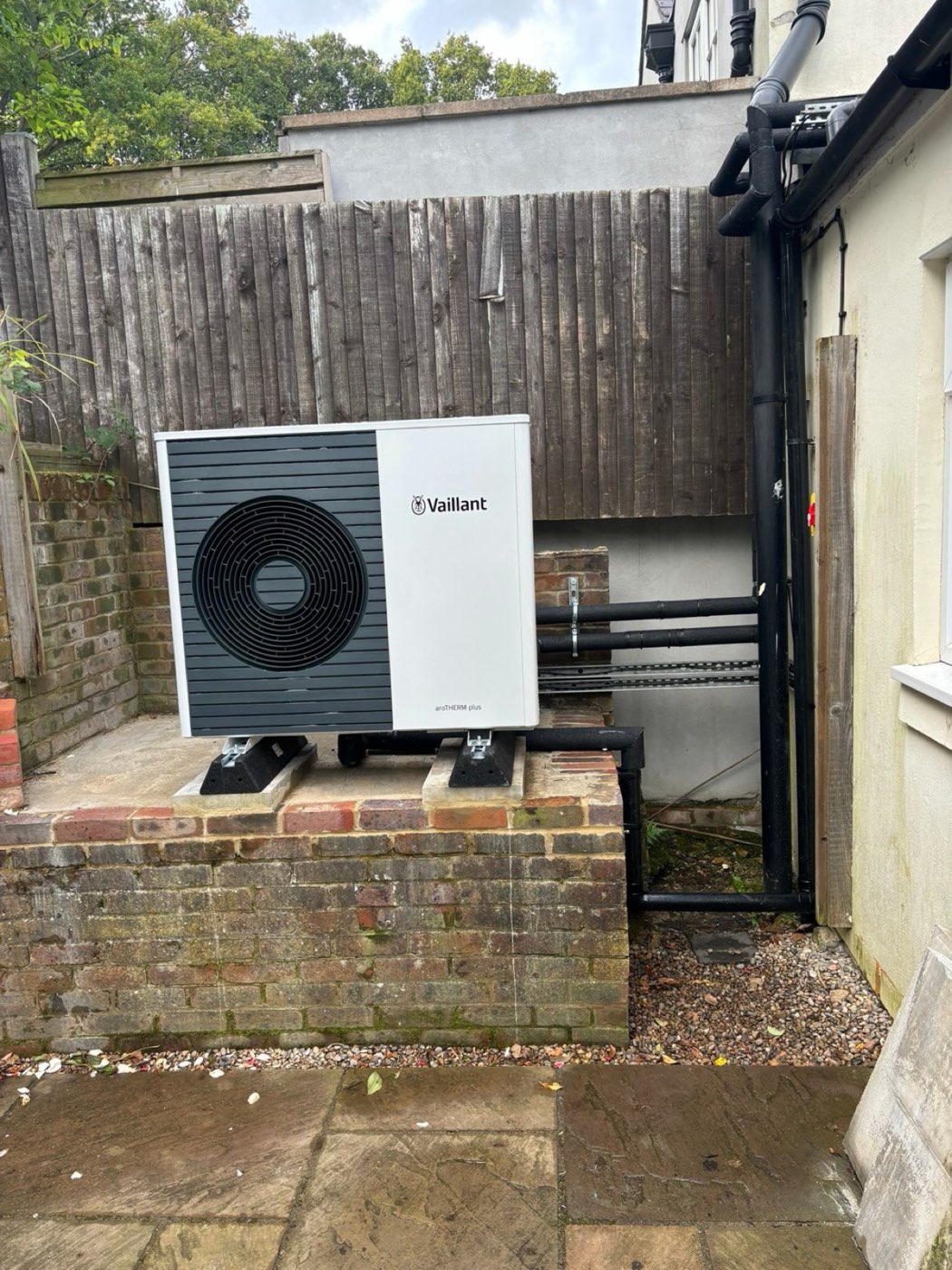
A big thanks to fellow YouTuber Andy Rogerson, aka EV Man, who asked for this one. He keeps getting comments asking how heat pumps actually work, especially below 0°C, and how on earth they could ever be more than 100% efficient.
To answer that, we first need to take a brief look at exactly how a heat pump works.
How a heat pump works
A basic ‘monoblock’ heat pump system consists of six components: a compressor, an expansion valve, a fan, an external radiator, a heat exchanger and internal radiators. They’re all connected by a pipe filled with refrigerant — a liquid with a very low boiling point.
When this refrigerant is warm, it’s in a vapour state (basically a gas), and when it’s cooled it turns back into a liquid.
When a heat pump is turned on, the compressor starts first. Held back by the expansion valve, it increases the pressure of the refrigerant gas on one half of the system. Compressing the gas crams the molecules tightly together so they collide and instantly heat up.
Imagine a deodorant can. When you release the deodorant, you can feel it cool your hand. If you were able to force it back in, it would get hot.
This heats up the heat exchanger, which transfers the heat into the water we pump around the radiators. As the water circulates the radiators it returns cooler, which cools down the plate and condenses the refrigerant gas back into a liquid.
That compressed refrigerant then passes through the expansion valve and decompresses. As it does so, it drops below the temperature of the outside air. This now very cold, low-pressure liquid passes through an outside radiator to collect heat from the air outside, with the help of a fan. It warms up, boils, becomes a gas again, and is returned to the compressor.
All of this is boosted by latent heat and phase change. Any liquid that turns into a gas absorbs what’s called latent energy — energy absorbed without a change in temperature. Any gas that turns back into a liquid releases that latent energy as heat, warming things up without cooling itself down.
This latent-energy principle is the exact same one that improves boiler efficiency by creating ‘condensing’ when you turn your boiler’s flow temperature down, and the same phase change that heat batteries rely on.
So it’s the outside air we get our thermal energy from. The electricity a heat pump uses simply enables us to move (or pump) that heat from the air outside and concentrate it into our radiators. The heat energy doesn’t come from the electricity — it comes from the air.
There are other versions of heat pump too, such as air-to-air, ground source and water source, and they all use exactly the same basic principle. If you’re weighing up an installation at home, our air source heat pump installation page walks through how these systems are sized and fitted.
How we measure energy: heat vs electrical — COP
So how can a heat pump be more than 100% efficient? It comes down to what we’re measuring.
With gas boilers, we measure how much gas we put in — let’s say 1kWh worth — and measure how much heat we get out, say 0.9kWh. That gives us 90% efficiency. If we do the same with a heat pump and measure 1kW of electricity in and 5kW of heat out, we’d have 500% efficiency. Let me explain.
To turn the energy in gas into heat, we burn it. Take 1kWh of gas, set it on fire and release 0.9kWh of heat. The missing 0.1kWh is lost in water vapour as uncaptured latent energy. Importantly, though, you pay for the power you use, not the heat gained.
Unlike a gas boiler, the energy source for a heat pump is the air outside, not its electrical power input. If you only measured the energy extracted from the outside air, you’d have 100% efficiency. If you included the electricity usage, you’d get to somewhere between 66% and 80% efficient.
So what is efficiency? The efficiency of a machine indicates how well its input energy is converted into useful output energy or work. It’s the output divided by the input, expressed as a percentage.
Now, we don’t pay for the abundantly warm air heated by the sun outside — we pay for electricity. So, using the same approach as gas boilers and only measuring the power you pay for, not the heat gained, if 1kWh of electricity gives us 5kWh of heat, the heat pump is 500% efficient.
This is what’s usually termed the coefficient of performance, or COP. A 500% efficiency would be a COP of 5.
How we measure heat pump efficiency
The efficiency at a single point in time is a pretty unfair marker, though, as it changes continuously throughout the day and year.
For example, say we’re at a COP of 5 when it’s 12°C outside — creating 5kW of heat with 1kW of electrical power. To keep your house warm when it’s 0°C outside you might need 10kWh of heat, and you may consume 3kWh of electricity. That gives a lower COP of 3.3, or 330% efficiency.
This varies because the ‘source and sink’ — the outside air where we source our heat, and the radiator temperature where we emit it — are further apart in temperature. The further apart they are, the harder the compressor has to work to create a wider pressure differential between the high- and low-pressure sides of the heat pump, which drives the radiator temperature up.
We can make the compressor work less hard by fitting larger radiators, so they don’t have to run as hot to heat the property, or by using weather compensation.
So now we know why it varies, we need to account for that when we talk about efficiency. Rather than referring to the COP, we normally refer to the SCOP or SPF.
- SCOP (seasonal coefficient of performance) is an estimate of the average COP over a whole year.
- SPF (seasonal performance factor) is the actual on-site measurement.
You might worry that the SCOP or SPF isn’t a fair measure, because an average across the year doesn’t reflect where most heat is generated — in winter. However, they represent the total kWh of heat created over a year divided by the total kWh of electricity consumed in the same period. Because the unit has to create more heat in winter, when it’s less efficient, the SCOP and SPF are naturally weighted towards those winter efficiencies.
Because of this, you can get an accurate understanding of your heat pump’s annual running costs even before installation, regardless of the lower winter efficiency.
What about below 0°C?
We’re often asked how heat pumps could possibly heat a home when it’s below 0°C, and told we’d be much better off with a boiler. In reality, they work perfectly well at negative temperatures.
When it’s 0°C or below outside, the air still has heat energy in it — 0°C is simply the freezing point of water, not the absence of heat. The real zero is known as absolute zero, which is −273°C. So unless you’re living down at those temperatures, there’s plenty of heat in the air for a heat pump to use.
Typical heat pumps are designed to work down to −20°C and can get your property up to temperature with no problems at all, provided the system is designed correctly, while still maintaining a good efficiency.
If you hear of people struggling to heat their homes with a heat pump when it’s this cold, that’s simply because the lower outside temperatures expose any design, installation and commissioning flaws.
If your COP dips to, say, 2.8 when it’s −1°C outside, that’s still 280% efficient with your electricity. A modern condensing gas boiler may only be 88% efficient in the same scenario. So yes, heat pumps aren’t quite as efficient in the depths of winter — but they’re still over three times more efficient than a boiler.
Of course, electricity is currently more expensive than gas, so whether that translates into annual savings for you depends on the numbers. If you’d like us to work that out for your home, you can book a heat pump survey and we’ll give you a realistic picture of the running costs.
Thinking about a heat pump?
As MCS-certified, Vaillant and Heat Geek installers, we design and fit air source heat pumps that perform efficiently all year round. Get a free, no-obligation assessment of your home.